Showing posts with label Audi. Show all posts

Audi A4 Allroad Quattro

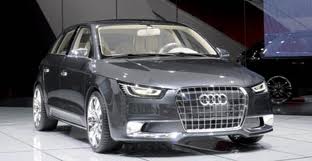
Audi A4 allroad quattro features all the innovative technologies which impart to the A4 model line its superiority: a range of powerful and highly energy-efficient engines, Audi drive select (intelligent handling technology), the high-tech S tronic transmission, and innovative communication and assistance systems. The vehicle will be available in early summer at a basic price of 37,100 euros.

The design of the Audi A4 allroad quattro recalls the Audi A4 Avant: crisp lines enclose tastefully curved surfaces and the low roof line establishes a coupé-like silhouette. Striking details re-interpret this model line's sporty elegance. The moon-gray single-frame radiator grille bears vertical chrome strips; an accentuated bumper and large air inlets underscore this vehicle's unique identity. Chrome rings encircle the fog lights. And in the option featuring xenon plus headlights, light-emitting diodes comprise the daytime running lights and taillights. Underneath the front end and tail end, the A4 allroad has a stainless-steel underbody guard.


Viewed from the side, the vehicle dazzles with flared wheel arches, angular sills (available with stainless-steel insert strips), and large wheels - 17-inch wheels in 7-arm design are standard. The roof is capped off by an offset rail with two high crosspieces. The width of the Audi A4 allroad quattro is emphasized by the rear bumper's distinctive styling and the integrated horizontal reflectors. On the 2.0 TDI, the two exhaust tailpipes appear side by side; on the 2.0 TFSI and 3.0 TDI, they terminate to the left and to the right.

The 2-liter TFSI - voted "Engine of the Year" on four consecutive occasions by an international panel of experts - incorporates three high-end technologies: FSI direct gasoline injection, the turbocharger, and the Audi valvelift system, which boosts pulling power by means of a variable control system. Between 1,500 and 4,200 rpm, the four-cylinder engine delivers 350 Nm of torque to the crankshaft. Peak output is 155 kW (211 bhp). In addition, the 2-liter TFSI propels the Audi A4 allroad quattro to 100 km/h (62.14 mph) in just 6.9 seconds, and to a top speed of 230 km/h (142.92 mph). On average, it consumes a mere 8.1 liters of fuel per 100 km (29.04 mpg).

As for the 2.0 TDI, the successor to the most successful diesel engine ever, a common-rail system providing injection pressure of 1,800 bar ensures excellent driving refinement. The two-liter diesel engine delivers 350 Nm between 1,750 and 2.500 rpm. A respectable 125 kW (170 bhp) provides admirable output, yet requires just 6.4 liters of fuel per 100 km (36.75 mpg). The Audi A4 allroad quattro 2.0 TDI reaches 100 km/h (62.14 mph) in 8.9 seconds and a top speed of 213 km/h (132.35 mph).

The very best of the three engines is the 3.0 TDI. This V6 diesel produces 176 kW (240 bhp) and transmits 500 Nm of torque to the crankshaft at 1,500 to 3,000 rpm. The 3.0 TDI in conjunction with S tronic propels the Audi A4 allroad quattro to 100 km/h (62.14 mph) in 6.4 seconds, and tops out at 236 km/h (146.64 mph). On average, the three-liter engine sips only 7.1 liters of fuel per 100 km (33.13 mpg). Like the other two engines, it already meets the EU's Euro 5 emission standard.

Audi A1 e-tron Concept

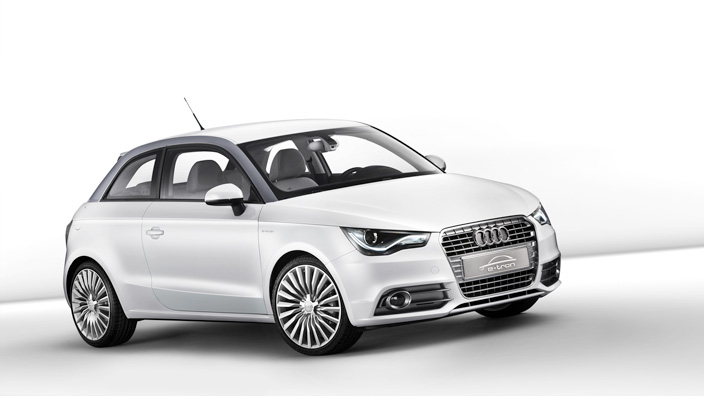
The Audi A1 e-tron Concept is a Mega City Vehicle (MCV) with an innovative drive technology. It comes equipped with a powerful electric motor for zero-emission driving in the city. There is also an internal combustion engine on board that recharges the battery in exceptional circumstances. The Audi A1 e-tron Concept is very agile thanks to the 75 kW (102 hp) peak power of its electric motor. The e-tron model family from Audi is just a few months old, but it already has a number of members, for each of which Audi has chosen a different drive technology. The first e-tron, which debuted at the 2009 IAA in Frankfurt/Main, is a near-series high-performance sports car with electric motors for all four wheels. The study shown at the Detroit Motor Show in 2010 is a lightweight, compact two-seater with two electric motors on the rear axle.


The Audi A1 e-tron Concept now presents another approach - a compact electric car in the premium class. The four-passenger, two-door MCV city car was designed specifically for use in the metropolitan areas of Europe and North America and in the rapidly growing megacities of Asia and South America. The Audi A1 e-tron always drives on electric power; its internal combustion engine is only used to recharge the battery in isolated cases.

The synchronous electric motor of the Audi A1 e-tron is mounted transversely at the front of the car. Its low mounting position has a positive effect on the vehicle's center of gravity. Continuous output is rated at 45 kW (61 hp), with peak power of 75 kW (102 hp) available in short bursts. 150 Nm (110.63 lb-ft) of torque is continuously available, and peak torque is 240 Nm (177.01 lb-ft).

The electric motor sends its power to the front wheels via a single-speed transmission. The elegant, retractable selector lever on the console of the center tunnel used to choose between "Drive," "Reverse," and "Neutral" was taken from the first Audi e-tron.

The power electronics are mounted in the engine compartment above the electric motor. The most important components are the pulse-controlled inverter, which serves as the controller between the electric motor and the battery; the DC converter, which connects the high-voltage network with the 14 volt electrical system; a breaker unit to protect the high-voltage components; and the charging module. The socket for the standard charging plug is located behind the rings in the single-frame grille of the Audi A1 e-tron. A fully depleted battery can be recharged in approximately three hours from the 380 volt grid. A display immediately adjacent to the plug-in connection shows the current charge status and the charging time remaining.

The concept of the innovative Mega City Vehicle requires the electrification of key auxiliaries. The refrigerant compressor of the climate control system, for example, is electrically powered by a high-voltage electric motor that supplies only the amount of power needed at the time.

This increases system efficiency substantially compared to conventional concepts. Thanks to a special circuit, the climate control loop also functions as a heat pump that regulates the temperature of the cabin and the battery.

The power steering of the Audi A1 e-tron is electro-mechanical and thus particularly energy-efficient. An electronic brake system makes it possible to tap into the recuperation potential of the electric motors. A hydraulic fixed-caliper brake is mounted on the front axle, with two novel electrically-actuated floating-caliper brakes mounted on the rear axle. These floating calipers are actuated not by any mechanical or hydraulic transfer elements, but rather by wire ("brake by wire"). In addition, this eliminates frictional losses due to residual slip when the brakes are not being applied. In addition, the servo unit received a new, demand-controlled electric vacuum pump.

The large electric motor powering the Audi A1 e-tron Concept can convert braking energy into electric current and feed it back into the electrical system. The high degree of recuperation benefits overall efficiency. The electric control actions are imperceptible to the driver, who notices only the familiar, precise, and perfectly controllable pedal feel.

Audi A1

The Audi A1 (internally designated Typ 8X) is a supermini-class car launched by Audi at the 2010 Geneva Motor Show. Sales of the initial three door A1 model started in Germany in August 2010, with the United Kingdom following in November 2010. The car is aimed mostly at young, affluent urban buyers. The A1 is designed to compete with the Mini, and Alfa Romeo MiTo. The A1 is produced at Audi's Belgium factory in Forest, near Brussels. The A1 is based on the Volkswagen Group PQ25 platform, the same platform used in the SEAT Ibiza Mk4 and the VW Polo Mk5, and in its development Audi has collaborated with SEAT. The A1 uses a MacPherson strut front and torsion beam rear suspension. The 100,000th A1 was produced in June of 2011.
The new Audi A1 also sets new efficiency standards. Audi is sending the new model line into the fray with four four-cylinder engines, with the two TDI and two TFSI gasoline engines producing between 63 kW (86 hp) and 90 kW (122 hp). All of the engines follow the downsizing principle - they substitute turbocharging for displacement and draw their fuel through direct injection units.

All versions of the Audi A1 impress with good fuel economy, with standard cycle values between 3.8 and 5.4 liters per 100 kilometers (43.56 - 61.90 US mpg) (provisional values). The 1.6 TDI with 66 kW (90 hp) and manual transmission emits only 99 g of CO2 per kilometer (159.33 g/mile). All of the engines are equipped with a recuperation system that allows them to recover energy during braking, and are coupled with an automatic start-stop system. A new temperature management system with switched water pump contributes to the low fuel consumption of the 1.2 TFSI.

Audi will initially offer the Audi A1 with four engines. The two TFSI gasoline engines and the two TDI diesels cover a power range from 63 kW (86 hp) to 90 kW (122 hp). Each of them is state-of-the-art. All of the engines employ direct fuel injection and turbocharging. This downsizing concept coupled with technologies from the Audi modular efficiency platform give them tremendous power with minimal fuel consumption ranging from 3.8 to 5.4 liters per 100 km (43.56 - 61.90 US mpg).

The entry-level gasoline engine is the new 1.2 TFSI. It generates 63 kW (86 hp) and produces its peak torque of 160 Nm (118.01 lb-ft) already between 1,500 and 3,500 rpm. Coupled with a five-speed manual transmission, the four-cylinder accelerates the Audi A1 from 0 to 100 km/h (0 - 62.14 mph) in 12.1 seconds on its way to a top speed of 179 km/h (111.23 mph). In the EU driving cycle, it consumes only 5.1 liters of fuel per 100 km (46.12 US mpg), which corresponds to only 119 grams of CO2/km (191.51 g/mile).

Audi RS6

The most recent tuning packages we’ve seen from Romeo Ferraris have been for some not-so-fast vehicles like the Abarth 500 and the Smart ForTwo. However, this time around, the Italian tuners have chosen the Audi RS6 to toy around with. The result of their work is a total of 720 HP and a top speed of 205 mph.

Now that’s a real Audi RS model! The tuning kit comes in two different engine upgrade stages. Stage one includes an ECU update and installation of two filters, allowing the Audi to get an extra 51hp. Not bad, but Stage two is oh-so-much better. This stage has the tuner optimizing the mapping of the two units (one per bank) and replacing the central component with high-performance metal catalysts combined with two 200-cell. The tuner can then install a new exhaust system if the customer so chooses. The result is an increase of 140 HP to 720hp (up from a standard of 580 HP). In order to manage this impressive update, the tuner is also offering a new Brembo front brake system.


Audi A4

Audi opens up new horizons. The A4 is a sporty car with superb presence on the road; it takes Audi forward into a new dimension on the midsize car market. The engines that power the saloon, both TDI and spark-ignition, in all cases with direct fuel injection, combine effortless power with high efficiency. The dynamic running gear and the use of many technologies taken direct from the large-car category are evidence of the brand’s lead in technical know-how. The new Audi is a new way to drive. It will reach the market at the end of November 2007, at a basic list price of about 26,000 Euros in Germany.
In its design, the new A4 reveals its sporty, progressive character: taut and dynamic in its outlines, it speaks the language of technical perfection. With an overall length of 4.70 metres, the saloon has a substantial, powerful road stance and offers its occupants ample space in an interior full of light. The workmanship is typical of an Audi – quality with no compromises. The controls can be backed by the extra refinement of innovative assistance and multimedia systems. In the safety area, the brand with the four-ring emblem sets new standards: the coordinated action of the airbags and front seat belt force limiters protects the occupants even more effectively.
When compared with the previous model, the A4 has new, sporty proportions. The front body overhang has been drastically shortened; the bonnet and wheelbase are both longer than before. In the driveline, the differential has changed places with the clutch (or torque converter), making it possible to move the front axle forward by 154 millimetres. This innovative solution ensures ideal axle-load distribution. The new A4 is the sportiest saloon in the midsize car category: agile, light and precise to control. Its dynamic suspension is a totally new design, with most of its components made from weight-saving aluminium. The results are impressive: supremely dynamic road behaviour and effortlessly precise handling.

Audi S5

Audi achieved a great success at the expense of the series A5. Although priced at a very high, but it did not dampen the demand to have the A5. With a fairly high level of sales for top-class cars, is proof that Audi is in great demand output wider community. This reason also that made Audi's attempt to issue a new series in the continuing success of the A5 series. Car latest release is called Audi S5.


The top models in the series - the S5 as Sportback, Coupé and Cabriolet - have also been refreshed. All S5 models, including the Coupé, are now equipped with the 3.0 TFSI producing 245 kW (333 hp). Compared to the 4.2-liter V8 it replaces in the Coupé, the supercharged V6 consumes on average 20 percent less fuel per 100 kilometers. Average fuel consumption is just 8.1 liters (29.04 US mpg) while performance remains impressive. The S5 Coupé accelerates from 0 to 100 km/h (62.14 mph) in just 4.9 seconds on its way to an electronically governed top speed of 250 km/h (155.34 mph).


Visual cues to the updated S models include new lights, modified body details and new crystal-effect paint finishes. Subtle changes can also be found in the interior. The most important technical updates for the Audi S5 are quattro drive with the crown-gear center differential and electromechanical power steering. The special S sport suspension and the standard 18-inch wheels deliver the power to the road.


A price not much different from the A5, the S5 is expected to achieve similar success with its predecessor. This car is reportedly to be launched in 2012. So we wait for the appearance and the excitement of next year.


Audi R8 GT

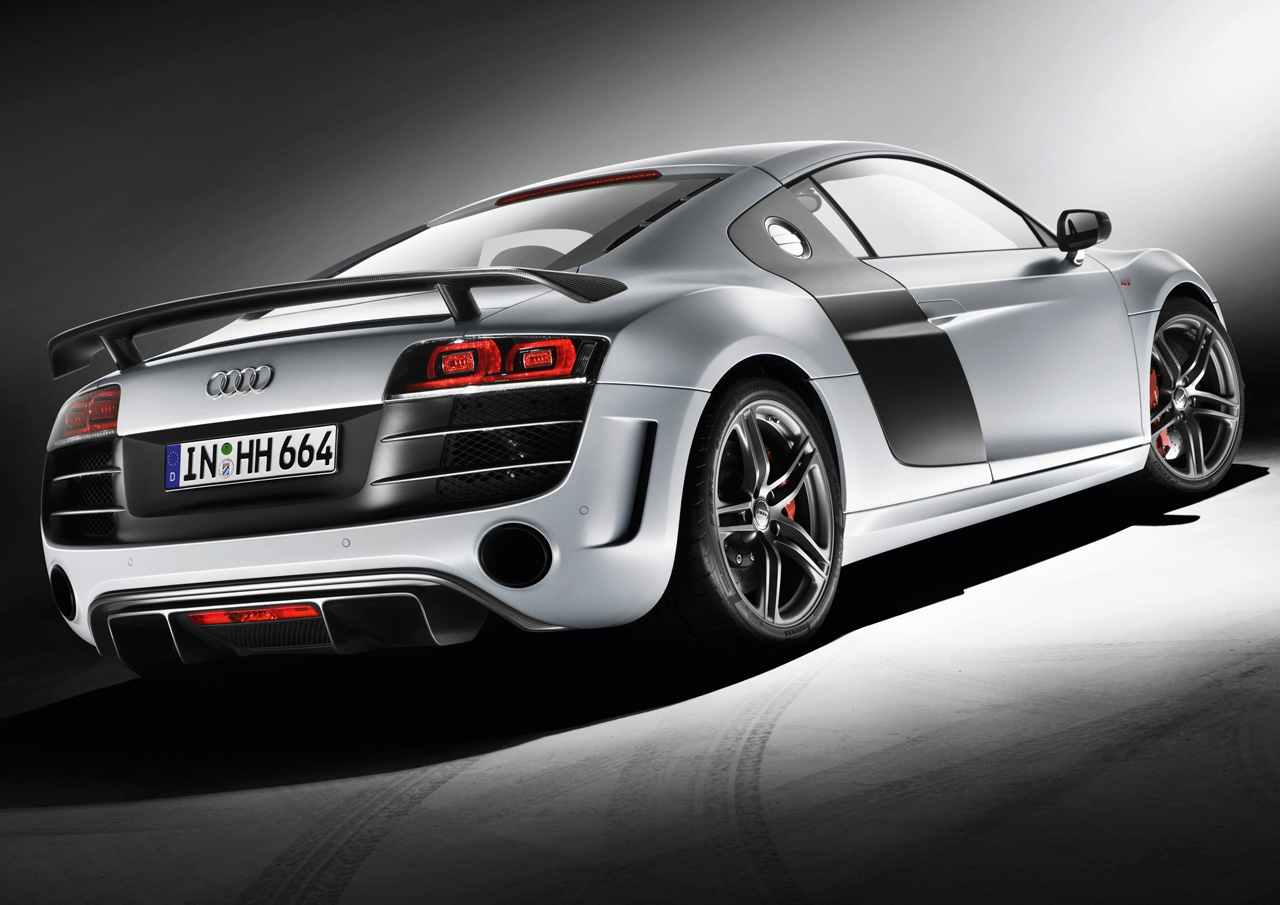
Audi is one of the carmaker, which until now continues to innovate in producing a classy cars. All the latest series from Audi is always awaited by his fans. In fact, each series issued will have a unique and distinctive to offer. Completion of the previous series became a tradition and innovation are endless. Like the one in this series R8. Now even more powerful, lighter and faster: Audi presents the Audi R8 GT - a limited-production version of the Audi R8 high-performance sports car. The output of its 5.2-liter V10 has been increased to 412 kW (560 hp); vehicle weight has been reduced by roughly 100 kilograms (220.46 lb). The Audi R8 GT accelerates from zero to 100 km/h (62.14 mph) in 3.6 seconds and reaches a top speed of 320 km/h (198.84 mph).

The R8 high-performance sports car has been a winner from the very beginning. This applies to both the production models, winners of the "World Performance Car" Award in 2008 (R8) and in 2010 (R8 V10), and to the race car, the R8 LMS, which won 23 races in its first season and claimed three championships. The genes of the race version are now coming to the street - in the Audi R8 GT. The exclusive series is limited to 333 units. Each Audi R8 GT has a badge with its production number on the shift lever knob.

The Audi R8 GT, which Audi sells in Germany for €193,000, comes with an automatic climate control system and power windows, a navigation system with MMI operating logic and a powerful sound system. A 465 watt, ten-channel Bang & Olufsen sound system, a CD changer and the Audi Music Interface are available as options. As always with Audi, the interior shows loving attention to detail. Rich materials spoil the occupants with a fine look and feel.

The ergonomic interior is adorned in sporty black and dark gray. The steering wheel, the headliner, the roof posts, the knee pad, the parking brake lever and the bucket seats are covered with Alcantara accented with contrasting stitching. A synthetic sharkskin-look material that feels slightly rough to the touch is applied to the bulkhead, the door liners, the instrument cowl and the dashboard. The "monoposto" - the arch in the cockpit - is made of matt carbon.

The instrument cluster features white dials with "R8 GT" badges. The newly designed selector lever is made of CFRP and aluminum; the center tunnel and the door liners sport decorative inlays in the body color. The door sills feature trims of matt aluminum decorated with the "R8 GT" logo.


Audi TT

Dynamic design, enthralling performance and exemplary efficiency – the Audi TT Coupe and the TT Roadster are now more attractive than ever. The design of the lightweight bodies made primarily of aluminum and the interior have been revised with great attention to detail, while new technologies lower the fuel consumption of the compact sports car. New to the lineup is a powerful and highly efficient four cylinder: The 2.0 TFSI develops 155 kW (211 hp), but is content with an average fuel consumption of just 6.6 liters per 100 kilometers (35.64 US mpg).
 Exterior DesignThe second generation TT Coupe and the TT Roadster have made a name for themselves as design icons, similar to their predecessors. Awards such as the 2007 “World Car Design of the Year” document this status. A brawny, broad foundation, powerful shoulders and a flat roofline – the two compact sports cars have fascinatingly masculine lines. Their dynamic appearance is now even more expressive than ever.
The most obvious feature at the front of the car is the powerful bumper, which frames the larger air inlets with three-dimensional, sharply drawn out edges. The fog lights are set in chrome rings. Also sporting a new look are the lattice of the single-frame grille in high-gloss black and the optional xenon plus headlights. Twelve white LEDs arranged in a straight line at the lower edge of the headlights serve as the daytime running lights. These together with the wings in the headlight body are classic Audi design features.
The tubular, apparently floating reflectors of the tail lights add visual depth to the rear end of the car. The large tailpipes of the exhaust system – the 2.0 TFSI features a dual exhaust – and the larger, flat black diffuser set additional accents. A spoiler that extends at 120 km/h (74.56 mph) improves downforce.

The upgrades to the TT Coupe and the TT Roadster have added two centimeters (0.79 in) to both cars, which now measure 4,187 millimeters (13.74 ft) in length. The width of 1,842 millimeters (6.04 ft) and the height of 1,352 millimeters (4.44 ft) and 1,357 millimeters (4.45 ft) for the Coupe and Roadster, respectively, remain unchanged. The wheelbase measures 2,468 millimeters (8.10 ft). Four new metallic colors have been added to the TT color range: Scuba Blue, Oolong Gray, Volcano Red and Dakota Gray. Daytona Gray, pearl effect is also available with the S line package.

BodyA key factor for the groundbreaking efficiency and excellent driving dynamics of the TT is the body, which features hybrid Audi Space Frame technology (ASF). Lightweight aluminum is used at the front of the car back to the B-pillar, with steel panels used at the rear. This mix enabled the development engineers to balance the axial loads perfectly and keep the total weight extremely low – prime parameters for dynamic performance.

The TT 1.8 TFSI weighs a mere 1,240 kg (2,733.73 lb), a good 100 kilograms (220.46 lbs) less than its closest competitor. The body of the Coupés weighs only 206 kilograms (454.15 lb), which breaks down to 140 kilograms (308.65 lb) of aluminum (68 percent) and 66 kilograms (145.51 lb) of steel (32 percent). The specific reinforcements in the TT Roadster – steel bulkhead, strongly ribbed sills, A-pillar and windshield frame – result in a 58 to 42 percent split of the two materials.

The ASF bodies of the TT are not only extremely lightweight, they are also very strong and low-vibration, providing the foundation for sporty and precise handling, the quiet ride and the high passive safety. A package of finely tuned retention systems protects the passengers in the event of a crash. The classic cloth top of the TT Roadster is a perfect complement to Audi’s lightweight construction principle. It contributes to a low center of gravity, fits ideally into the design line and takes up little space when folded.
Audi offers the soft top in two variants. The manual version features a central latch for opening and closing the top. An electrohydraulic drive opens the optional fully-automatic top in just 12 seconds, even while driving at speeds up to 50 km/h (31.07 mph). An additional acoustic mat further improves the already excellent acoustics and thermal insulation.

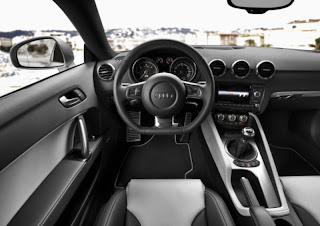
InteriorThe interior of the TT features a sporty design, dynamic elegance and generous amounts of space. The standard sport seats are mounted low and offer a high level of lateral support. The steering wheel is flattened at the bottom. The five round air vents and the arched cowl over the round-dial instruments exude the spirit characteristic of the TT. The ergonomics are logical and the fit and finish is uncompromisingly precise – just like always with Audi. When the ignition is turned, the dials of the speedometer and tachometer briefly run up to the limit before returning to zero.

The designers have added additional gloss to the fine interior. New aluminum-look applications shine on the steering wheel, the center console and in the door liner. Elegant accents are provided by rings, frames and strips in high-gloss black. The aluminum strip above the glove box door is now brushed gray. There are three new interior colors from which to choose – nougat brown, titanium gray and garnet red. The leather seat covers are specially treated to reduce thermal heating by as much as 20 degrees Celsius (68° F) when the TT is parked in the sun.
The TT Coupe and the TT Roadster are sports cars with a high degree of everyday utility. The backs of both rear seats fold down in the 2+2-seater Coupé, expanding the trunk space beneath the long lid from 292 to 700 liters (10.31 – 24.72 cubic ft). The Roadster, which offers 250 liters (8.83 cubic ft) of storage space whether the top is up or down, can also be supplied with the option of a load-through facility.

DrivetrainThree four-cylinder engines with turbocharging and direct fuel injection are available for both the TT Coupe and the TT Roadster. The two TFSI gasoline engines and the TDI combine sporty performance with groundbreaking efficiency – their fuel consumption figures have been reduced by up to 14 percent. All three engines are coupled with a recuperation system that recovers energy during braking and coasting phases.
New to the lineup is the 2.0 TFSI with 155 kW (211 hp), which replaces the 2.0 TFSI with 147 kW (200 hp) and the 3.2 FSI. With a manual transmission, the two-liter engine accelerates the Coupe from zero to 100 km/h (62.14 mph) in 6.1 seconds on its way to a top speed of 245 km/h (152.24 mph). Audi also offers the 2.0 TFSI with an optional drivetrain featuring the six-speed S tronic and quattro permanent all-wheel drive. The spring from zero to 100 km/h (62.14 mph) takes only 5.6 s in this configuration.

The Audi valvelift system AVS in the new 2.0 TFSI increases power, torque and efficiency. Equipped with a manual transmission, the TT 2.0 TFSI consumes only 6.6 liters of fuel per 100 km (35.64 US mpg) in the European test cycle. CO2 emissions are an exemplary 154 grams/km (247.84 g/mile). The best value posted by a competitor is 199 g/km (320.26 g/mile). Fuel consumption has improved by 1.1 liters/100 km over the previous model.

The 2.0 TFSI is a winner par excellence, having been named “Engine of the Year” five years in a row by an international jury. Its technology package combines high output with impressive pulling power. A constant 350 Nm (258.15 lb-ft) of torque are available between 1,600 and 4,200 rpm. The long-stroke engine, which is extremely cultivated thanks to two balance shafts, has been painstakingly optimized for minimal friction.
The Audi valvelift system adjusts the lift of the exhaust valves in two stages depending on need. This reduces flushing losses in the combustion chamber and also ensures that the optimal flow of the exhaust gas is directed to the turbocharger, which in turn ensures that torque is developed quickly.
The combination of turbocharging and direct fuel injection also reduces the combustion chamber temperatures and the resulting tendency to knock. This allows a high compression ratio of 9.6:1, which improves efficiency.
The TT engine lineup includes two other four-cylinder engines besides the new 2.0 TFSI. The 1.8 TFSI, available with a six-speed manual transmission and front-wheel drive, delivers 118 kW (160 hp) and 250 Nm of torque (184.39 lb-ft), the latter between 1,500 and 4,500 rpm. It launches the Coupe from a standing start to 100 km/h in 7.2 seconds, with a top speed of 226 km/h (140.43 mph). It consumes just 6.4 liters of fuel per 100 km (36.75 US mpg) on average, which corresponds to only 149 grams of CO2/km (239.79 g/mile). The TT 2.0 TDI remains the only sports car with a diesel engine in its segment, and its efficiency clearly sets the standard. The TT Coupe consumes just 5.3 liters of fuel per 100 km (44.38 US mpg), which corresponds to only 139 grams of CO2/km (223.70 g/mile). With 125 kW (170 hp) and 350 Nm (258.15 lb-ft) of torque – the latter available between 1,750 and 2,500 rpm – the standard sprint takes 7.5 seconds and acceleration continues until a top speed of 226 km/h (140.43 mph) is reached. The two-liter TDI is mated to a manual transmission and quattro all-wheel drive.

A precisely shifting six-speed manual transmission transfers power to the wheels regardless of the engine. Audi also offers the S tronic dual clutch transmission as an option for the new 2.0 TFSI. This transmission switches between its six gears with virtually no interruption to the supply of power. The high-tech gearbox shifts extremely quickly and comfortably, either fully automatically or manually as the driver desires. Manual shifts can be made using the optional paddles on the steering wheel.
The quattro permanent all-wheel drive system is available as an option for the 2.0 TFSI with the S tronic; it comes standard with the 2.0 TDI. The hydraulic multi-plate clutch, which is mounted on the rear axle in the interest of weight distribution, is electronically controlled. During normal driving, it sends most of the engine’s power to the front wheels, but can quickly transfer up to 100 percent to the rear wheels, if necessary.
The quattro drive provides substantially greater stability, traction and driving enjoyment, and is another unique selling point of the Audi TT in its class.

ChassisThe front suspension features McPherson struts, with aluminum components used to keep the weight of the unsprung masses low. The power steering is direct, sensitive and thanks to its electromechanical drive, highly efficient. The trailing arms of the four-link rear suspension are relatively soft in the interest of comfort. The connections to the three transverse links per wheel, on the other hand, are rigid in order to direct lateral forces into the body with precision.
Available as an option with all variants of the TT is the electronically controlled Audi magnetic ride shock absorber system, another high-tech feature that underscores the unique character of the compact sports car. A fluid containing tiny magnetic particles circulates through the dampers. When a voltage is applied to the magnetic field, the behavior of the particles changes and thus the damping behavior of the fluid changes. A computer fed with input from a bundle of sensors controls the adaptive damping.

The driver can choose between two base characteristics, which are now even more clearly differentiated. In “Normal” mode, the movements of the TT Coupe and the TT Roadster are balanced – equally agile and comfortable. In “Sport” mode, high damping forces largely suppress body roll. The TT is tautly connected to the road, and its setup is highly dynamic.

Another option is available in addition to Audi magnetic ride – the Sport button. The driver can use it to adjust the characteristic of the gas pedal (with manual transmissions), the amount of servo boost for the steering and the engine sound in two stages.
The range of wheels has also been reworked, and now features 14 variants. The TT 1.8 TFSI, the 2.0 TDI and the 2.0 TFSI roll off the assembly line on 17-inch aluminum wheels with size 245/55 tires.
Winter wheels are available in three sizes; the range of summer wheels extends all the way up to 9 J x 19 with size 255/35 tires. Mounted behind the large wheels are powerful brakes with large-diameter discs. The front discs are internally ventilated.

Equipment and TrimAll versions of the TT Coupe and TT Roadster come with a rich array of standard equipment. Among the highlights are the “chorus” audio system, a driver information system and – in the TT Coupe– an automatic climate control system. Two navigation systems, a universal cellular phone preparation and the sonorous Bose Surround Sound system are available as options. The optional xenon plus headlights can be combined with a cornering light function.
The onboard computer with efficiency program comes standard in the TT. It displays all of the consumption-relevant data on the central display, and gives the driver tips for efficient driving. The gear-change indicator indicates the proper gear. Another function provides information on which vehicle systems, such as the climate control system, are consuming energy and how that effects fuel consumption.

Customizing fans will find a rich selection available in Color & Trim. It begins with the optional leather upholstery and includes four leather packages, an application package and two S line packages. The S line exterior package focuses on design modifications in the area of the bumpers, the air inlets and the diffuser. The S line sport package features a black interior with many fine details in such places as the steering wheel, the seat covers and the applications. 18-inch wheels and body lowered by 10 millimeters (0.39 in) make the handling even more dynamic.
The updated TT Coupe and the TT Roadster will debut on the German market this summer with only minimal changes in price. The 1.8 TFSI will be available from €30,200.

The Audi TTS and the Audi TT RSThe Audi TTS, both in Coupe and Roadster body styles, combine enthralling sportiness with cultivated comfort. Its two-liter TFSI with the large turbocharger and many additional modifications pumps out 200 kW (272 hp) and 350 Nm (258.15 lb-ft) of torque, the latter from 2,500 to 5,000 rpm. It accelerates the TTS Coupe with the optional S tronic from zero to 100 km/h (62.14 mph) in 5.2 seconds, up to a governed top speed of 250 km/h (155.34 mph). With the S tronic, the Coupé consumes an average of only 7.7 liters of fuel per 100 km (30.55 US mpg).
The TTS comes standard with the Audi magnetic ride adaptive shock absorber technology, the Sport button and a high-performance brake system. Visual cues to its identity are provided by the 18-inch wheels with size 245/40 tires and a new grille combined with chrome air inlets. A new color combination – spectral silver/black – is available for the interior.

The dynamic spearhead of the TT model series is the TT RS, which is likewise available as a Coupe or a Roadster. Its turbocharged, inline 5-cylinder engine draws 250 kW (340 hp) of power from 2.5 liters of displacement. 450 Nm (331.90 lb-ft) of torque are available between 1,600 and 5,300 rpm. It nevertheless averages just 9.2 liters of fuel per 100 km (25.57 US mpg).
The TT RS Coupe rockets from 0 to 100 km/h (0 to 62.14 mph) in 4.6 seconds; quattro GmbH will raise the top speed from 250 to 280 km/h (155.34 to 173.98 mph) upon request. A sound flap in the exhaust system further intensifies the distinctive five-cylinder sound. A manual six-speed transmission with a sportily narrow gearing currently delivers the power to the quattro permanent all-wheel drive. Starting this fall, Audi will also offer the option of the TT RS with a newly developed version of the S tronic that can handle the tremendous torque of the powerful five-cylinder engine. The compact layout of the seven-speed, dual-clutch transmission makes it suitable for transverse mounting in combination with the quattro all-wheel drive system.

The TT RS Coupe with the S tronic launches itself from zero to 100 km/h (62.14 mph) in 4.4 seconds. The TT RS Roadster requires 0.1 seconds more for this discipline – a bat of an eye less than with the manual transmission. Distinctive design details, 18-inch wheels and an extremely powerful brake system are standard with the TT RS.

Audi R8 Spyder

Audi's V10 supercar, as written by kompas.com, now comes with a retractable roof for open-air thrills. If it’s good enough for the Porsche 911 Turbo, the Lamborghini Gallardo and a range of other supercars, then Audi obviously thinks it’s time its R8 flagship went topless, too.
But unlike many coupes converted to a folding roof layout, the $376,000 (in manual form) R8 Spyder isn’t simply an R8 coupe with the roof lopped off. Rather it’s a complete redesign that builds on the coupe’s aluminium space-frame construction to maintain torsional rigidity (body stiffness).

Audi R8 Spyder

The front panels including the bonnet and front guards are made from aluminium, while the rear panels starting with the rear haunches and the engine cover that doubles as the roof’s tonneau are moulded from carbon-fibre. The R8 coupe's distinctive side-blade disappears from the Spyder.
Bucking the modern trend for folding metal roofs, the R8 Spyder uses a cloth top which is both lighter, simpler and more compact than a metal lid, yet it’s still electrically operated, folds up or down in just 19 seconds and lives above the mid-mounted engine so it robs no luggage or cabin space.

While some world markets will get a V8-powered version of the Spyder, the only version brought to Australia will be the megastar V10 version which uses the engine lifted from the Lamborghini Gallardo.
In R8 Spyder form, that means an engine pushing out 386kW at 8000rpm and 530Nm of torque at 6500rpm, all without the aid of a supercharger or turbocharger. Audi claims 0-100km/h in a neat 4.1 seconds, and it's hard to argue with that from the seat of the pants feel.


The manual gearbox option for the R8 Spyder is a six-speed unit complete with a gated shifter while the six-speed clutchless manual, dubbed R-Tronic (which takes the sticker to a mighty $392,000) is a bit old fashioned in that it still uses a single clutch layout while the rest of the world is rushing to embrace the technically superior twin-clutch arrangement.
But while it might seem last year's news on paper, on the race-track the gearbox works beautifully, matching revs to road speed accurately and doing pretty much exactly as the driver instructs.

Audi R8 Spyder

Handling and grip via the Quattro all-wheel-drive system helps make the big Audi about as fool-proof as a hyper-car could ever be. There are enormous reserves of traction and plenty of tyre grip to help out and the magnetic ride control can tailor the dynamics from supple-ish to race-track tough.
The soundtrack is pretty amazing, too, with a slightly offbeat idle rising to a roaring top end as the revs approach 8000rpm. Even starting the car is an aural experience with a mighty woomph as the engine catches on the starter and 5.2 litres of air are sucked into the thing every revolution.
Options include ceramic brakes front and rear at a huge $25,422, extra leather trim at $8700, Audi's sportier bucket seats at $9100 and even a kit that includes carbon-fibre inlays for some of the interior trim at a thought-provoking $5720.


Standard gear, meanwhile, runs to the adaptive suspension, a Bang and Olufsen stereo, bluetooth connectivity (including clever microphones built into the driver's seat-belt for phone calls with the roof down) heated seats and full LED headlights.
Supercars are not for everyone, of course, and neither are convertibles with theoretical top speeds around the 300km/h mark. But then, neither are price-tags that, with all the options and on-road costs could easily tip the wrong side of $450,000.