Showing posts with label Ferrari. Show all posts

Ferrari 612 GTO

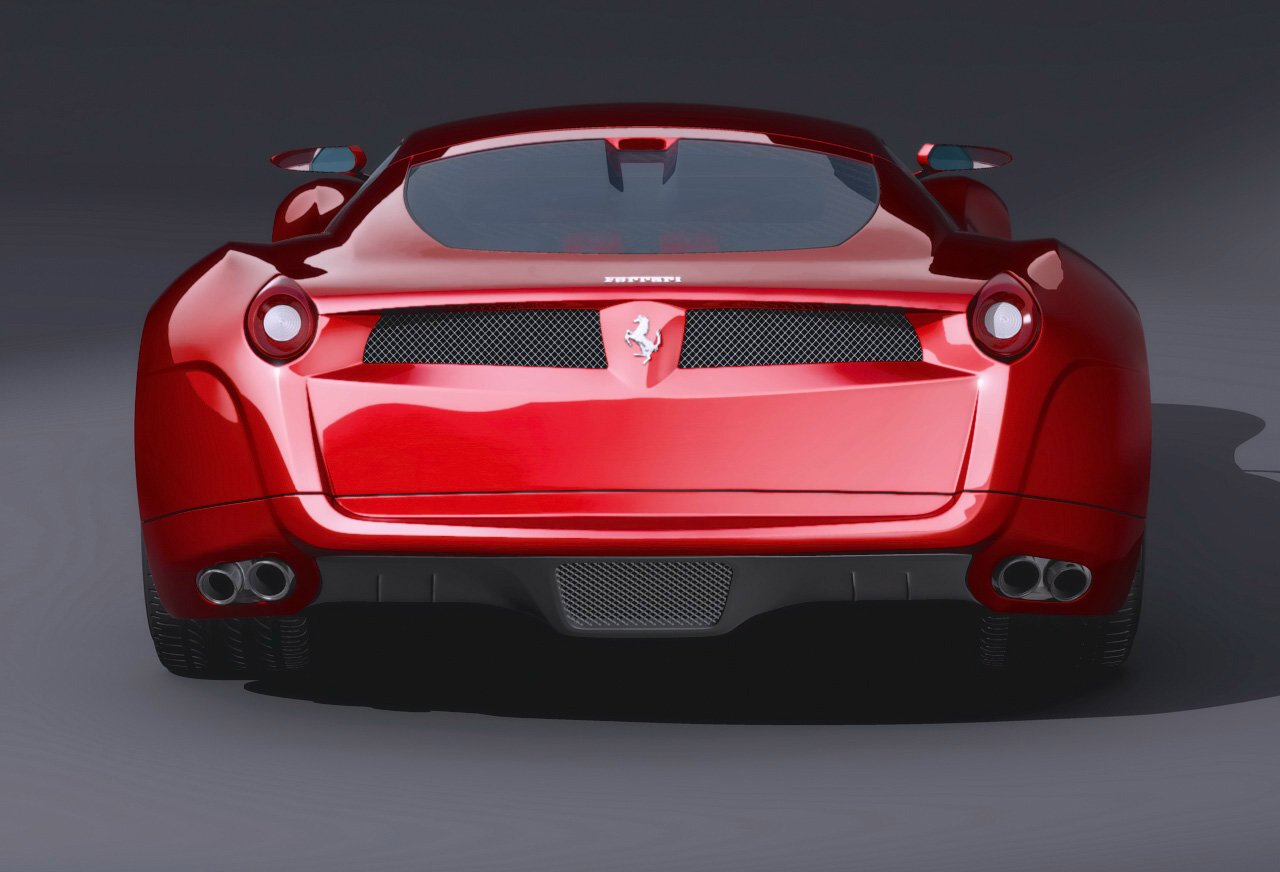
There does not seem that unlikely or impossible in this world. Including technology and other modern car design. The designers competing to provide unique and distinctive touch to the cars they design. They provide beauty and aerodynamics converge within a framework of a typical body. Several prominent designers who are designing the Adam Denning Navarra Concept for Lamborghini. Also there Selipanov Sasha who designed the Ferrari 612 GTO. Sasha himself famous as a character designer car "angry".
Ferrari 612 GTO is a Ferrari a purely conceptual study of the upper level, perhaps the next generation of 612 Scaglietti.Keunikan Selipanov design of the proposal is to borrow pieces from other supercars like the Aston Martin One-77 and 458 Italian and Classical Maranello 250 GTO, and mixed with unique styles.
The overall results of Selipanov concept is very positive, because of the high quality rendering in the eyes of the car. Since this is still in study design, so no details can be disclosed in detail here. To be sure, we can not deny that the figure 612 GTO Sasha's work is very interesting. He also designed the various forms of other interesting designs that you can see in angrycardesigner.com. Most of the design is the Ferrari.

Ferrari 458 Italia Grand Am

Ferrari 458 Italian Grand Am is a sports car built by Ferrari with a slight modification in the appearance and also the engine. Various updates carried out by Ferrari in order to make the Ferrari 458 Italian Grand Am into a car that is sporty and also looks more aggressive. After making its track debut at home in Fiorano, the Ferrari 458 Italia Grand Am will be back in action on 26 and 27 July, 2011 for a private test session at Florida's Daytona International Speedway. Taking turns at the wheel will be the tried and tested duo of Jaime Melo and Toni Vilander who can pride themselves of having an extensive list of wins to their name in Ferraris. They will continue development work on the Ferrari 458 Italia Grand Am in preparation for its participation in the 2012 American championship.

The Ferrari 458 Grand Am is built to match the American regulations and is therefore different to the European car, especially in that it develops 500 horsepower and has less efficient aerodynamics than the GT version. It is also fitted with a 48 mm restrictor and maximum revs are 8000. Significant modifications have been made to the braking system, as the car has neither ABS nor traction control. Other differences to the GT3 include the roll-over bar which gives greater lateral protection to increase safety in a series in which collisions are rather more frequent.
The car is fitted with tyres from Continental, the sole supplier to the series, featuring a very hard compound, again to conform with the series regulations. On its shakedown today, it completed a good number of trouble-free laps, 45 to be precise in the hands of Maurizio Mediani and Jaime Melo, as they took turns at the wheel.

Daytona recalls many memories of past Ferrari victories in the famous 24 Hour race, the company having close links with this important event. In fact, Ferrari has taken part in 47 of these endurance races, winning five of them outright as well as taking 15 class wins.

Standing out in that list was an amazing clean sweep of the podium in 1967 for the two Ferrari 330 P4 and a 412 N.A.R.T., while back in 1962, Phil Hill and Ricardo Rodriguez won in a Dino 246 SP. That year, no less than four Ferraris finished in the top ten while in 1972, Mario Andretti and Jacky Ickx won in a 312 PB.Ferrari 458 Italian Grand Am is a highly innovative cars and sporty, therefore, has a lot of people who can not wait to see the appearance of the Ferrari 458 Italian Grand Am anymore. With a design that has been designed with advanced concepts, will make the Ferrari 458 Italian Grand Am became more interesting and cool.

Ferrai 458 Italia

Ferrari car manufacturers really are not tired to innovate. One is the output of a series of 459 Italian dream of all the millionaires in the world. The Ferrari 458 Italia is a mid-engined sports car produced by the Italian sports car manufacturer Ferrari. The 458 Italia replaces the Ferrari F430. The 458 Italia was officially unveiled at the 2009 Frankfurt Motor Show on 15 September 2009.
 Engine
The 458 Italia is powered by a 4.5 L (270 cu in) V8 engine derived from a shared Ferrari/Maserati design, producing 562 hp (419 kW; 570 PS) at 9,000 rpm (redline) and 398 lb·ft (540 N·m) at 6,000 rpm[5] with 80% torque available at 3,250 rpm. Due to the aerodynamics pushing more air into the engine at high speeds, the engine develops 570 HP at top speed. The engine features direct fuel injection, which is a first for Ferrari mid-rear engine setups in its road cars.
Transmission
The standard transmission is a Getrag dual-clutch 7-speed transmission, similar to the Ferrari California. There is no traditional manual option, making this the fourth road-car after the Enzo, Challenge Stradale and 430 Scuderia not to be offered with Ferrari's classic gated manual. It is the first mainstream model to not be offered with a manual transmission.
Handling
The car's suspension features double wishbones at the front and a multi-link set-up at the rear, coupled with E-Diff and F1-Trac traction control systems, designed to improve the car's cornering and longitudinal acceleration by 32% when compared with its predecessors.
The brakes include a prefill function whereby the pistons in the calipers move the pads into contact with the discs on lift off to minimise delay in the brakes being applied. This combined with the ABS has reduced 100–0 km/h (62-0 mph) braking distance to 32.5 metres (107 ft). The adaptive magnetorheological dampers were co-developed with Delphi.
Performance
Ferrari's official 0-100 km/h (62 mph) acceleration is under 3.4 seconds, while top speed is over 325 km/h (202 mph), with a fuel consumption in combined cycle (ECE+EUDC) 13.7 L/100 km (20.6 mpg-imp; 17.2 mpg-US) while producing 320g/km of CO2. 
Price
Since car values vary and Ferrari does not publish prices of its cars on its website, it is hard to tell what the value of the Ferrari 458 Italia is currently. As of February 2010, the Ferrari 458 Italia was selling for around £25,000 over its £169,545 UK list price.
Design
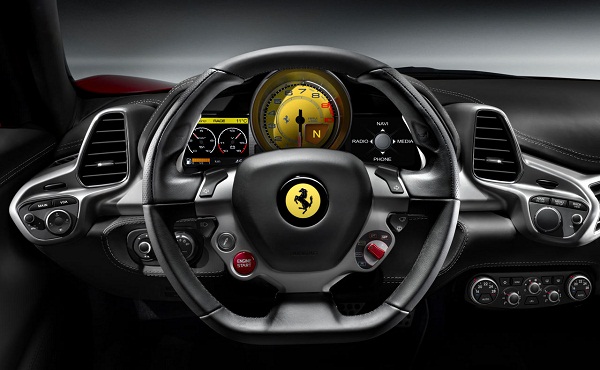
The body was designed by Pininfarina, as with all recent Ferrari models. The car’s exterior styling and features were designed for aerodynamic efficiency, producing a downforce of 140 kg at 124 miles per hour (200 km/h). In particular, the front grille features deformable winglets that lower at high speeds, in order to offer reduced drag. The car's interior was designed using input from former Ferrari Formula 1 driver Michael Schumacher, including a new steering wheel design which incorporates many features and controls as opposed to their being on the dashboard, similar to racing car designs.

According to British car magazine Autocar, the 458 Italia's design has drawn inspiration from the Enzo Ferrari and its Millechili concept car. It has been designed to be Ferrari's sportiest V8-engined car, to distinguish itself from the recently launched Ferrari California.

The 458 was also reviewed on 15th season of Top Gear, where it received acclaim for its styling and performance. In a drag race against a Ferrari F430, it won by a considerable margin. The car also lapped the Top Gear test track in 1:19.1, just 0.1 seconds slower than the Enzo Ferrari.

Ferrari F40

Ferrari F40 was Ferrari's most expensive, sophisticated, and the fastest from 1987-1992.F40 is the successor of Ferrari 288 cars GTO.F40 is the last before the death of Enzo Ferrari Ferrari.F40 replaced by F50. This car is powered by 2.9 L twin-turbo V8 is located behind its middle. It weighs only 1.100kg, making it one of the lightest super car. Some components use strong, lightweight materials like carbon fiber and aluminum.
Ferrari F40
Ferrari F40 can run from 0-100 km / h in only 3.8 seconds. Maximum speed is 320 km / h.
Ferrari F40 is only produced as much as 1315 units. Total production is following the tradition in which Ferrari's most expensive product sold in very small amounts, so be very exclusive.
F40 compete with rivals in the 80s super car, the Porsche 959 and Lamborghini Countach.


Ferrari Enzo

For this time the Ferrari produced a car with the same series with the founder of Ferrari's own, Enzo Ferrari. This car is dedicated specifically for the Enzo which has brought the concept of a super car fast, sophisticated, and futuristic. This car is also produced very limited, namely only 399 units worldwide.
The Enzo Ferrarri Enzo features a V12 engine with four valves per cylinder. The engine displacement is about 4700 cc and it delivers an output power of 660 bhp and 485 lb-ft torque. The Ferrari Enzo reaches the speed of 60 mph in 3.4 seconds and the top speed is about 217 mph. The Ferrari Enzo features 6-speed Semi-Automatic transmission and the gear shifts can be performed easily and smoothly even at higher loads.
The wheels are wrapped with Bridgestone tires and it features carbon ceramic discs with six piston calipers. The car also features Anti Braking System and power steering. The exteriors feature the stylish body structure, headlights and tail lights. The interiors are mostly designed of carbon fiber and it features the air conditioning system, navigation system and the optional launch control.

Spesification
Engine
Type: rear, longitudinal 65° V12
Bore/stroke: 92 x 75.2 mm
Unitary displacement: 499.90 cc
Total displacement: 5998.80 cc
Compression ratio: 11.2 : 1
Maximum power: 485 kW (660 hp) at 7800 rpm
Power per litre: 110 hp/l
Maximum torque: 657 Nm (67 kgm) at 5500 rpm
Valve actuation: twin overhead camshafts per bank, four valves per cylinder
Fuel feed: Bosch Motronic ME7 injection
Ignition: Bosch Motronic ME7 electronic static, single spark plug per cylinder
Lubrication: dry sump
Clutch: twin-plate

Chassis
Frame: carbon-fibre and Nomex honeycomb monococque
Front suspension: independent push-rod, unequal-length wishbones, coil springs, telescopic shock absorbers with electronic adaptive damping
Rear suspension: independent push-rod, unequal-length wishbones, coil springs, telescopic shock absorbers with electronic adaptive damping
Brakes: carbon-ceramic discs
Transmission: electro-hydraulic F1 6-speed + reverse
Steering: rack-and-pinion
Fuel tank: capacity 110 litres
Front tyres: 245/35 ZR 19
Rear tyres: 345/35 ZR 19
Bodywork
Type: two-seater berlinetta
Length: 4702 mm
Width: 2035 mm
Height: 1147 mm
Wheelbase: 2650 mm
Front track: 1660 mm
Rear track: 1650 mm
Weight: 1255 kg (dry)
Performance
Top speed: over 350 km/h
Acceleration 0-100 km/h: 3.65 sec
0-400 m: 11.00 sec
0-1000 m: 19.60 sec

Ferrari 360 GT

Ferrari 360 GT is one of Ferrari production car designed specifically for race cars. With a futuristic body, and the machines that are quality, 360 GT won several victories and at the same awards in racing. One of them is now winning the race in the event JMB race in Estoril. This is proof that the Ferrari 360 GT is one of the cars with speed and power are balanced in every race.
 The 2002 Ferrari 360 GT is very much like the cars that JMB raced in 2001. Again, Michelotto is responsible for the body developments which hold Pininfarina's original lines. Bodywork revisions include a NACA duct on front lid for interior cooling, wider front and rear fenders, a larger, more developed rear wing and a new front valance which can support the optional driving lights.
 Since the introduction of the 360 Modena, Ferrari has received numerous requests for factory-prepared cars for other international championships. With the help of factory backing, the JMB Competition team 360 fought off the Porsche competition to take the 2001 FIA N-GT World Championship team and drivers' titles.
On the strength of this showing, Ferrari has decided to produce a specific model - the 360 GT - derived from the Challenge car for privateers in the FIA N-GT and A.C.O. (Automobile Club de l'Ouest) championships in 2002. Production will be strictly limited to around 30 cars over the next three years and the ex-factory price (ie. excluding tax and delivery) is 382,000 Euros for the FIA version, and 402,000 Euros for the ACO version. The two versions differ exclusively for the aerodynamic packages and, in the case of the FIA car, the adoption of the F1-style shift.

As for mechanics, Ferrari has considered every component. The engine features, high-lift camshafts, lighter pistons, reshaped combustion chambers and re-mapped mototronics. Even with two 30.8mm air restrictors, the engine produces 430HP. This is a remarkable figure given that air restrictors stop about half of the air reaching throttle bodies.
The suspension remains similar to the production 360, having harder springs, shocks and an adjustable anti-roll bar.
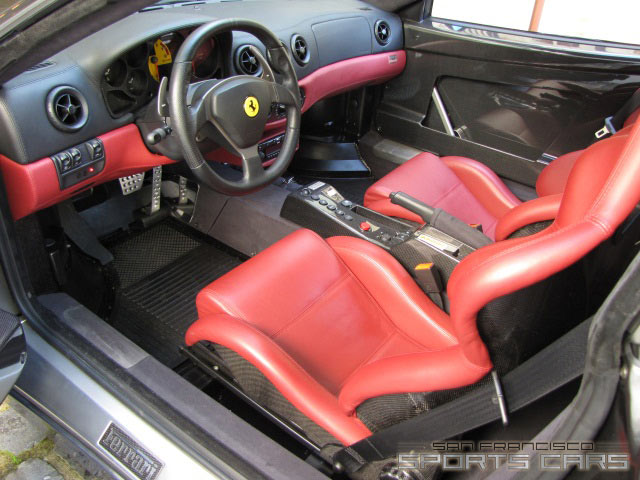
Like every racecar the 360 GT is stripped of its interior luxuries with all non-essential components removed. The gauges are replaced with a digital display and a full roll cage is installed. In total, Ferrari engineers shed 600lbs off the production 360, which makes it 400 lbs lighter than the Challenge car.
Spesification
Engine
Type: rear, longitudinal 90° V8
Bore/stroke: 85 x 79 mm
Unitary displacement: 448.29 cc
Total displacement: 3586.20 cc
Compression ratio: 11:1
Maximum power: 316 kW (430 hp) at 8500 rpm
Power per litre: 120 hp/l
Maximum torque: 377 Nm (38.5 kgm) at 5000 rpm
Valve actuation: twin overhead camshafts per bank, five valves per cylinder
Fuel feed: Bosch electronic injection
Ignition: Bosch electronic, single spark plug per cylinder
Lubrication: dry sump
Clutch: single-plate

Chassis
Frame: aluminium spaceframe
Front suspension: independent, unequal-length wishbones, coil springs over telescopic shock absorbers, anti-roll bar
Rear suspension: independent, unequal-length wishbones, coil springs over telescopic shock absorbers, anti-roll bar
Brakes: discs
Transmission: electro-hydraulic F1 6-speed + reverse
Steering: rack-and-pinion
Fuel tank: capacity 100 litres
Front tyres: 265/645 x 18
Rear tyres: 305/680 x 18
Bodywork
Type: two-seater berlinetta
Length: 4557 mm
Width: 1985 mm
Height: 1185 mm
Wheelbase: 2600 mm
Front track: 1728 mm
Rear track: 1643 mm
Weight: 1100 kg (dry)

Ferrari Challenge Stradale

Since Ferrari an exhibition at the Geneva Motor Show in 2003, Ferrari and then hold improvements and repairs to launch the latest version of the car. This car is expected to be the successor to the success of Ferrari 360 Modena. With various modifications made to the Ferrari Challenge Stradale finally created.
The Challenge Stradale lines up alongside the 360 Modena and 360 Spider with the precise AIM of the performances drivers Providing That only a true racing car for road use Provide cans.
 The experiences coming from the Ferrari Challenge International Championships and the FIA GT races, have allowed Ferrari to develop solutions Technicians make the Challenge Stradale That really unique.
This strong links to racing is Underlined not only by a significant weight reduction, but Also set up by its engine, aerodynamics, braking system and the F1 style gearbox.
Spesification
Engine
Type: rear, longitudinal 90° V8
Bore/stroke: 85 x 79 mm
Unitary displacement: 448.29 cc
Total displacement: 3586.20 cc
Compression ratio: 11.2 : 1
Maximum power: 313 kW (425 hp) at 8500 giri/min
Power per litre: 119 hp/l
Maximum torque: 373 Nm (38 kgm) at 4750 rpm
Valve actuation: twin overhead camshafts per bank, five valves per cylinder
Fuel feed: Bosch Motronic ME7.3 electronic injection
Ignition: Bosch Motronic ME7.3 static electronic, single spark plug per cylinder
Lubrication: dry sump
Clutch: single-plate

Chassis
Frame: aluminium spaceframe
Front suspension: independent, unequal-length wishbones, coil springs over telescopic shock absorbers, anti-roll bar
Rear suspension: independent, unequal-length wishbones, coil springs over telescopic shock absorbers, anti-roll bar
Brakes: carbon-ceramic discs
Transmission: electro-hydraulic F1 6-speed + reverse
Steering: rack-and-pinion
Fuel tank: capacity 95 litres
Front tyres: 225/35 ZR 19
Rear tyres: 285/35 ZR 19

Bodywork
Type: two-seater berlinetta
Length: 4477 mm
Width: 1922 mm
Height: 1199 mm
Wheelbase: 2600 mm
Front track: 1669 mm
Rear track: 1617 mm
Weight: 1180 kg (dry)
Performance
Top speed: 300 km/h
Acceleration 0-100 km/h: 4.1 sec
0-400 m: 12.1 sec
0-1000 m: 22.0 sec

FERRARI FF

In last February, Ferrari launched a new variant of fast car that is named Ferrari FF, in Maranello. Ferrari Party says that is claimed to be the most exclusive cars in terms of design, technology and machinery. This car carrying the 6300 cc V12 engine that powered 651 horsepower at 8000 rpm and torque of 683 Newton meters at 6,000 rpm. Armed with that power, Ferrari FF capable sped up to 325 kilometers per hour (kpj) and acceleration from rest to a speed of 100 kpj within 3.7 seconds. This car also became the first Ferrari car that four-wheel (4WD), and devices equipped with dual clutch transmissions of F1 cars.

This car is much referred to as a substitute for the Ferrari 612 Scaglietti, but the newer car is superior than the Scaglietti. Problem fuel consumption for example, Ferrari FF more efficient. Even compared to Ferrari California Hele (High Emotion Low Emission), this car is more economical 23 percent.

Ferrari's claim that thanks to a series of sophisticated features, levels of FF consumption reached 15.4 liters for 100 kilometers. The level of CO2 emissions that is down to 350 kilograms per kilometer. This amount is quite low compared to the Ferrari 612 Scaglietti which amounted to 470 grams per kilometer.
Another advantage is the capacity of a wide cabin and the latest generation of entertainment devices with touch screen 5 inches. So also with the capacity reaching 450 liters luggage can even be enlarged to 800 liters when the rear seats folded.

Engine
Type: 65 ° V12
Total displacement: 6262 cc
Bore / stroke: 94 mm x 75.2 mm
Maximum power: 660 CV at 8000 rpm
Maximum torque: 683 Nm at 6000 rpm
Specific power: 77 kW / liter - 105 CV / liter
Maximum revs: 8000 rpm
Compression ratio: 12,3:1

Dimensions and Weight
Length: 4907 mm
Width: 1953 mm
Height: 1379 mm
Wheelbase: 2990 mm
Front track: 1676 mm
Rear track: 1660 mm
* Dry weight: 1790 kg
* Kerb weight: 1880 Kg
Weight distribution: 47% fr, 53% r
Boot volume: 450 liters
Fuel tank capacity: 91 liters

Wheels and Tyres

Front: 245/35 ZR 20 8.5 J x 20 "
Rear: 295/35 ZR 20 10.5 J x 20 "
Rear (winter Tyres): 285/35 ZR 20 10.5 J x 20 "

Brakes
Front: 398 mm x 38 mm
Rear: 360 mm x 32 mm
Transmission and Gearbox
4RM (four-wheel drive) and 7-speed dual-clutch transmission
Electronic Controls4RM control (full integration of all controls: F1-Trac, the E-Diff and PTU), ABS / EBD, ESC

Suspension
SCM3

Performance
Top speed: 335 km / h
0-100 km / h: 3.7 sec
0-200 km / h: 11 sec
100-0 km / h: 35 m
Weight / power ratio: 2.7 kg / CV

Consumption and Emissions
Consumption: 15.4 l/100 km
CO2 emissions: 360 g / km

FERRARI F70

In the past Ferrari made ​​a car that is projected as a tribute to its founder, Enzo Ferrari. Now this super fast car manufacturer will make the successor of the Ferrari Enzo. The car is claimed to have advantages and speed of its predecessor.
As you May already know, the exotic Italian automaker Ferrari is Busy Preparing a successor for Their last anniversary Celebrating hello super car, the Enzo. It only makes sense That the future car will from be Called the F70 in honor of a 70th anniversary and is Promised to be unveiled Sometime in 2012. The upcoming F70 Would Compete head to head with other high end limited edition super cars like the Lamborghini Reventón and Bugatti Veyron. There will of only 399 F70s be produced and prices will from range in the $ 1 Million regions.

With high efficiency on Their List of Priorities, Ferrari wants to keep the future F70's weight to a minimum (1000 kilograms), just like the Millechilli. Now this would be a substantial undertaking for any ordinary automaker, but the Ferrari is ready to apply every weight saving technique in Their arsenal. While the Enzo was powered by a high-revving V12 That made ​​650 HP, the F70 will from use a new direct-injection twin-turbo V8, Quite similar to the legendary F40, with output in the area of 660 HP. This Should Be Enough for the future super car to sprint from 0 to 60 MPH in under three seconds and the F70's top speed will of go up to 230 MPH.